Englewood Lives
Dwight Morrow History
By Norman Davis, Former President of the Englewood Historical Society
In October of 1931 a funeral at Englewood’s First Presbyterian Church was attended by an overflow crowd which included ex-President Calvin Coolidge and several members of the then current President’s cabinet. The deceased was Dwight Whitney Morrow – an Englewood resident who had suddenly died at the age of 58 after returning from a trip to Europe. Morrow at the time was a United States Senator representing New Jersey – and his face had recently appeared on the cover of TIME magazine with an accompanying article suggesting his suitability as Republican candidate for President in the 1932 election.
Morrow was easily the most prominent person ever to reside in Englewood. His unusual personal combination of a brilliant mind and a warm personality enabled him to fill with distinction a wide variety of professional and public service roles over a more than thirty-year career. He became one the most admired figures of his era.
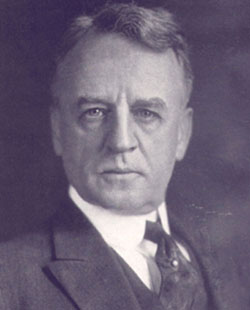 Morrow was born in West Virginia and spent his youth in suburban Pittsburgh where his father was a school principal. In 1891 he enrolled in Amherst College in Massachusetts, where he was a classmate and friend of future US President Calvin Coolidge. On graduation in 1895 he was voted by his class “Most likely to succeed.” While at Amherst he courted Elizabeth Reeve Cutter, who was attending nearby Smith College, and later became his wife. After graduation, Morrow attended Columbia Law School, and then joined the New York law firm of Simpson, Thatcher and Bartlett.
In 1903, Morrow married Elizabeth Cutter and moved to Englewood, New Jersey. In the following years, they had four children and moved to larger homes as his law career prospered. In 1913, at the urging of Englewood neighbors and J P Morgan partners Thomas Lamont and Henry Davison, Morrow himself became a Morgan partner. J P Morgan was at the time the most prominent and powerful financial institution in the country, serving as banker to major domestic and foreign corporations. As partner, Morrow served as director on many corporate boards and became immensely wealthy.
As World War I began in 1914, Morgan provided major financing to Great Britain and France to buy war materials. After the U S entered the war in 1917, Morrow offered his personal services to the government and played an important role in managing shipping and supplies. President Wilson appointed him chief civilian aide to General Pershing.
In 1920, Morrow acted as campaign manager for Calvin Coolidge, who was
seeking the Republican nomination for President. Instead, Coolidge was
nominated and elected Vice President, and became President on the death of
Warren Harding in 1923.
In 1925, Morrow was asked by Coolidge to chair a Board of civilian and military experts to make recommendations regarding the rapidly growing aviation industry. Colonel Billy Mitchell of the Army Air Service had stirred up much controversy with his views regarding the importance of aviation in future wars, and been court-martialed as a result. After extensive hearings, the Morrow Board made recommendations, which were largely adopted. These included separation of military and civilian aviation and the establishment of an Army Air Corps. Morrow’s best-known role was as Ambassador to Mexico from 1927 to 1930. He resigned from Morgan and moved to Mexico, where he quickly signaled the desire of the U S for more friendly relations. He established a close relationship with President Calles, and travelled widely through the country, often with popular Americans such as Will Rogers and the newly famous aviator, Charles Lindbergh. He successfully negotiated an agreement between the anticlerical government and the Vatican, permitting the reopening of the Catholic churches.
Morrow’s daughter Anne met her future husband Lindbergh in Mexico.
Upon their return to the U S, the Morrows occupied their new mansion, built on their 75 acres in the northeast quarter of Englewood called Next Day Hill. Morrow was chosen to fill a vacant seat in the U S Senate, and soon gained attention by being the first prominent Republican to advocate repeal of Prohibition.
The new Englewood high school under construction at the time of his death was named in his honor.

Sign up to get the latest news
Keep up to date on our programs, events, and progress, and stay in touch to learn about upcoming opportunities to learn about Englewood’s past and present!